How does AI search actually work?
Author
Joe Plankinton
Date Published
How ChatGPT and Google's AI Decide Which Businesses to Recommend
By Joe Plankinton Jr, HoneyBadger-Designs. Last updated November 2026.
When someone asks ChatGPT, Perplexity or Google's AI answer who to call, the tool runs a few searches, reads a handful of websites, and names the two or three it trusts most. To be one of those names, your website needs three things. The AI has to trust your business, it has to be able to read your pages, and your pages have to answer what people actually ask. None of it takes special tricks. Most of it is fixable on a normal small business website.
Here's how it works, and what you can do about it.
How does AI search actually work?
All the big AI search tools work about the same way.
Say someone types "who should I call for a new website in Lawrence, Kansas?" The AI doesn't answer from memory alone. It breaks the question into a few smaller searches, like "web designers in Lawrence KS", "small business website cost" and "web designer reviews Lawrence". It reads the pages that come back. Then it writes one short answer and names the few sources it leaned on.
That means your website has two jobs. It has to show up in those searches, which is still mostly regular SEO. And once the AI is reading it, your page has to be the one it decides to trust and quote.
Google says this plainly. Its guidance for site owners says, "There are no additional requirements to appear in AI Overviews or AI Mode, nor other special optimizations necessary." Your page has to be in Google and allowed to show a preview, and it has to be useful. That's the whole list.
ChatGPT and Perplexity behave a little differently. They tend to favor newer content and are more willing to name a small specialist business. They also lean on sites like Reddit, YouTube and Wikipedia.
What is E-E-A-T?
E-E-A-T stands for Experience, Expertise, Authoritativeness and Trust. It comes from the handbook Google gives the people it pays to grade search results by hand.
- Experience asks whether the person writing has actually done this. Photos of your own work and stories from real jobs show it.
- Expertise asks whether they know the subject. Licenses, certifications and years in the trade show it.
- Authoritativeness asks whether other people treat you as a go-to source. Reviews, local news mentions and links from associations and partners show it.
- Trust asks whether a visitor can trust the page and the business. A real address and phone number, clear pricing, a secure site and accurate information show it.
Google calls trust the most important of the four. The other three are ways of proving you can be trusted.
Two things about E-E-A-T surprise most owners. First, there's no E-E-A-T score. You can't install a plugin to get it. It's a description of what a good page looks like, and Google's systems look for those signals in a lot of indirect ways. Second, health, money, legal and safety topics are held to a much higher standard. Google calls those "Your Money or Your Life" topics. If you run a clinic or give financial advice, this part matters most.
What is GEO?
GEO stands for Generative Engine Optimization. Regular SEO tries to rank your page in a list of ten links. GEO tries to get your page into the AI's answer. You'll also hear it called AEO (Answer Engine Optimization) or LLM SEO. They mean about the same thing.
The term comes from a 2024 study by researchers at Princeton and IIT Delhi. They built 10,000 test questions, changed websites in different ways, and measured how much an AI answer used each page.
Adding citations, quotes from real people and real statistics each raised how much the AI used a page by about 30 to 40 percent. Making the writing smoother and easier to read helped by 15 to 30 percent. Keyword stuffing did worse than leaving the page alone. And sites that ranked lower to begin with gained the most, which is good news for small businesses competing with big brands.
One honest note: the researchers ran their tests on an older version of ChatGPT and on Perplexity, not on today's Google AI answers. The direction is useful, but the exact numbers won't carry over one for one.
What are the three things AI search looks for?
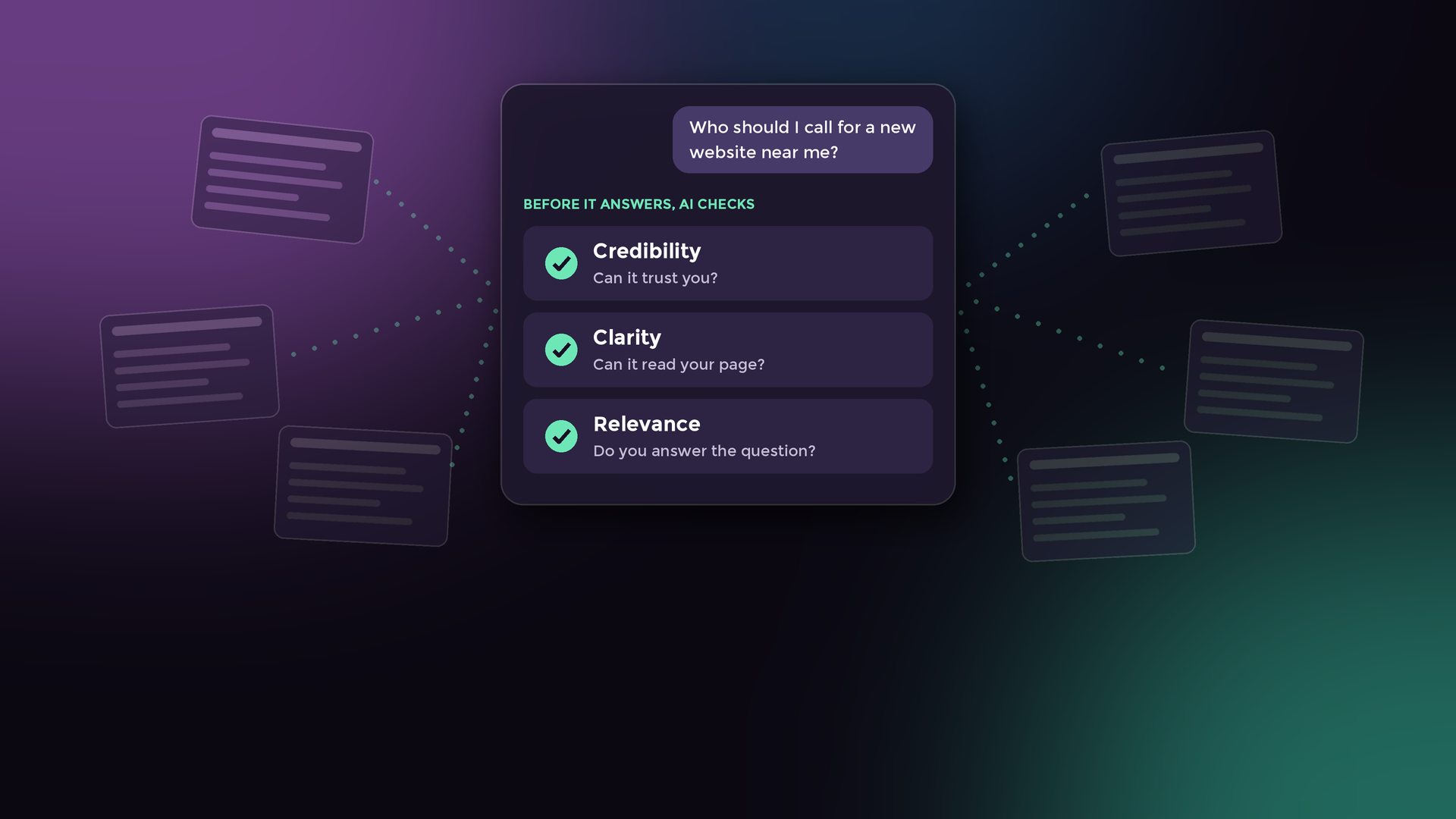
A U.S. Chamber of Commerce guide for small businesses put it well. Credibility, clarity and relevance "still make all the difference in your brand's search visibility." Here's what each one means for your website.
Credibility: can the AI trust you?
This is E-E-A-T in practice. The AI is about to repeat your name to someone, so it looks for proof you're real.
- Your business name, address and phone number, and the same ones everywhere you're listed
- Reviews, and a real person's name and background on the site
- Photos of your own work instead of stock photos
- Sources for any numbers you quote
- Mentions on other sites, like local news, directories, associations, Reddit and YouTube
A common problem is information that doesn't match from one place to the next. If your website, Facebook page and Google Business Profile each list different hours, the AI has a hard time trusting any of them.
Clarity: can the AI read your page?
The AI pulls short pieces out of your page to build its answer. Make those pieces easy to find.
- Put the answer first, then explain. If the question is cost, give the price range up top.
- Use one topic per section, with a heading that says what the section answers.
- Keep prices, hours, menus and services in plain text. Put information inside an image or a PDF and the AI can miss it. Google's own advice is to keep important content in text form.
- Use short paragraphs, and use a table or list when you're comparing things.
Relevance: do you answer what people really ask?
Think about the questions customers ask you on the phone. "How much is it?" "Do you come out to my town?" "How long does it take?" Write those questions on your site, in their words, and answer each one.
Be specific about where you are and who you serve. "Serving Lawrence and Douglas County since 2015" gives the AI something to match. "Quality service you can trust" gives it nothing. Keep pages current too, because a price list from 2023 isn't relevant in 2026.
Here's how the three fit together. Relevance gets your page found in the AI's search. Clarity gets it used in the answer. Credibility gets your business named.
Do I need an llms.txt file or special code?
For Google, no. Google says you don't need special files, AI text files or new markup to appear in its AI features. Schema markup that matches what's on the page still helps search engines understand you, and it's worth having.
Other AI tools may or may not read an llms.txt file. It doesn't hurt to have one, but don't count on it to get you named.
How can I check what AI says about my business?
This takes about five minutes. Open ChatGPT, Perplexity and Google, and ask each one:
- "What do you know about [your business name]?"
- "Who would you recommend for [what you do] in [your town]?"
Write down what comes back. Is it right? Is it out of date? Does it name a competitor instead? That's your starting point, and if you check again in a few months, you'll know whether your changes made a difference.
Frequently asked questions
Will this get my business recommended by ChatGPT?
Nobody can promise that. These tools change often and decide for themselves. What you can do is make it easy for them to trust you, read your site and match it to the question.
Is GEO different from SEO?
They overlap a lot. Good SEO gets your page into the AI's search results. GEO is about what happens next, when the AI decides which pages to quote.
How long does it take?
Fixes to your own site, like plain-text prices, clear answers and matching contact info, can be picked up the next time search engines read your site. Reviews and mentions on other sites build over months.
Do I need to write differently for AI?
Write for your customers, clearly and specifically. The things that help an AI quote you are the same things that help a customer decide to call: real numbers, real answers and proof you've done the work.
Sources
- Google Search Central, "AI features and your website": https://developers.google.com/search/docs/appearance/ai-features
- Aggarwal et al., "GEO: Generative Engine Optimization," KDD 2024: https://arxiv.org/abs/2311.09735
- U.S. Chamber of Commerce, "How to Improve Small Business AI Search Visibility with GEO," December 2025: https://www.uschamber.com/co/start/strategy/geo-ai-search-visibility
- Search Engine Land, "An SEO guide to understanding E-E-A-T": https://searchengineland.com/guide/google-e-e-a-t-for-seo
About the author: Joe Plankinton Jr runs HoneyBadger-Designs, a small web, software, and marketing shop that helps small businesses get found online and turn visitors into customers.